

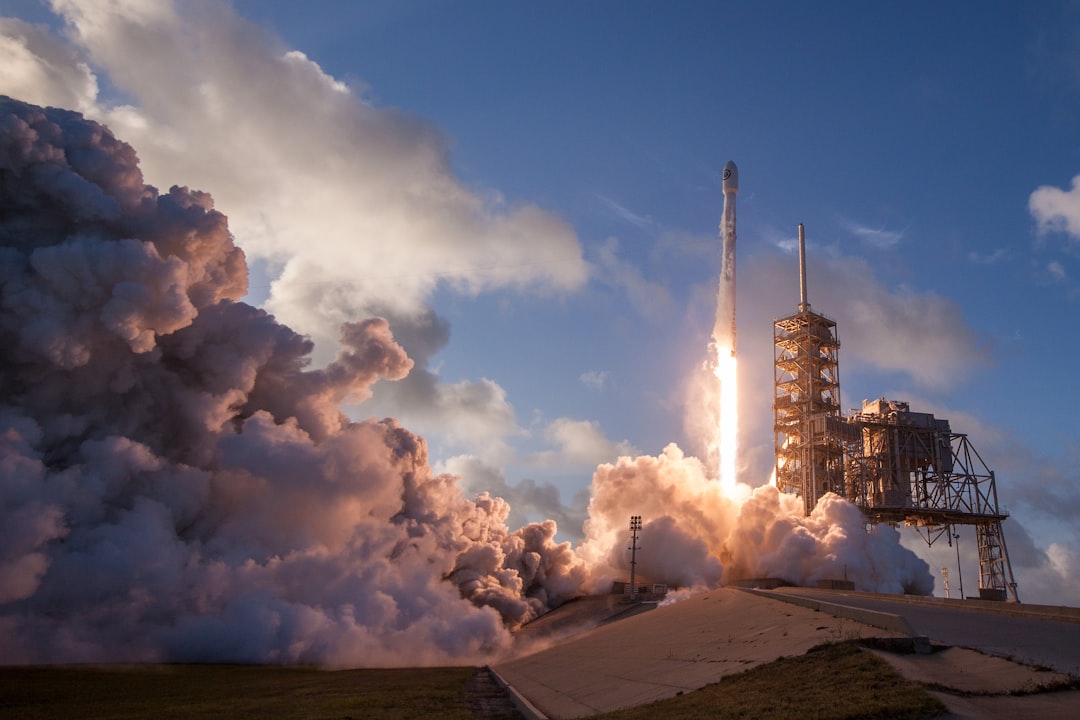
The phrase “space technology new business” might conjure images of rockets and astronauts — but what’s actually happening right now, in May 2026, is far more interesting, and frankly far more profitable than most people realize. We’re not talking about the distant future. We’re talking about satellite data reshaping insurance payouts in Mozambique within days of a cyclone, about a farmer in Kenya getting a crop loss claim settled without a single adjuster ever visiting the field, about a startup in Toronto building orbital launch vehicles with AI-guided guidance systems. This is already the world you’re operating in. Whether you know it or not.
Why Space Technology New Business Opportunities are Bigger than the Headlines Suggest
Here’s the thing. When most people hear “space economy,” they think NASA budgets and SpaceX launch videos. They don’t think about the quiet infrastructure revolution underneath it all.
The Space Foundation’s Space Report 2025 Q2 revealed that the global space economy reached an unprecedented $613 billion in 2024 — reflecting strong 7.8% year-over-year growth — with the commercial sector accounting for 78% of that total. Read that again. Seventy-eight percent is coming from private enterprise, not governments. That ratio alone tells you where the opportunity is.
The global space technology market is projected to grow from USD $652.75 billion in 2026 to $1.14 trillion by 2034, exhibiting a CAGR of 7.2% during that period. And those projections, conservative as they tend to be, don’t fully account for compounding second-order industries built on top of space infrastructure — the analytics platforms, the fintech apps, the precision agriculture tools, the parametric insurance products. Those are where the real entrepreneurial white space lives.
The single biggest unlock? Cost. Launch prices have decreased by more than 90 percent in the last fifteen years, which has enabled business models that were merely theoretical when going to orbit was priced at tens of thousands of dollars per kilogram. That’s not incremental change. That’s the kind of cost collapse that created the mobile app economy after smartphone penetration hit scale.
How Space Technology New Business Models are Disrupting Legacy Industries
Let’s get specific. Because “disruption” is a word that gets thrown around until it means nothing.
Insurance Gets a Radical Overhaul
I remember reading about a $5.4 million parametric insurance payout and doing a double-take at how it was processed. In October 2025, the Government of Mozambique received $5.4 million to deal with the aftermath of a drought and a tropical cyclone — paid out in days, not months, with nobody from an insurance company visiting the country to verify what had happened. That payout was triggered by satellite data crossing a pre-agreed threshold. Automatic. Instant.
Between 2022 and mid-2025, 405 Earth observation satellites entered orbit across imaging, radar, meteorology, and climatology missions, tripling global monitoring capacity. That density of coverage is what makes parametric insurance scalable. Commercial operators now control 78% of EO assets, led by Planet Labs’ 115-satellite constellation, signaling a shift from government-run observation programs to a privatized, on-demand infrastructure that trades data as a strategic asset.
For insurers, the math is compelling. Earth observation satellites have enhanced crop insurance by closing the gap between reported and actual conditions, enabling insurers to verify damage, model yield risk, and issue payouts with unprecedented precision. Swiss Re is already at this table. So are AXA Climate and dozens of regional players who simply couldn’t underwrite these risks before satellites made verification affordable.
Agriculture Finance Follows the Data
In Brazil, banks are integrating EO data to dynamically adjust loan terms based on in-season crop performance. That’s a product that didn’t exist a decade ago. You can now build a fintech company that underwrites agricultural credit using real-time satellite imagery rather than a loan officer’s annual farm visit. The unit economics are better. The default modeling is sharper. The scale potential is global.
The Launch Cost Revolution that Made Space Technology New Business Viable at Scale
Let’s be honest — none of this conversation happens without the rocket economics shifting.
SpaceX completed 134 launches in 2024, capturing over 50% of global commercial launch market share and establishing a pricing ceiling that all competitors must operate under. That pricing ceiling is the key detail. SpaceX didn’t just get cheaper — it forced the entire industry to restructure around affordability. Rocket Lab, Arianespace, and a cluster of emerging launch startups are all competing in a market that SpaceX effectively repriced.
SpaceX reportedly generated $15–16 billion in revenue in 2025 with an estimated $8 billion in profit, making it one of the most profitable private companies on Earth. Profitable. That word matters enormously. It means this isn’t venture-backed moonshot territory anymore (mostly — depends on the specific sub-sector you’re entering).
The Space Report 2025 Q2 also highlights the record pace of space launch in the first half of 2025, with a liftoff to orbit every 28 hours — six hours faster than the annual record set in 2024. Frequency of access to orbit is the underlying metric that determines how fast downstream businesses can build and iterate.
The winners here aren’t necessarily the launch companies themselves. The winners are the businesses that use cheap, frequent access to orbit to build recurring data and service businesses. Software economics wrapped around hardware infrastructure. Earth observation and analytics offer the best risk-adjusted returns for builders with domain expertise, with lower capital requirements compared to manufacturing or launch enabling focused companies to build differentiated products — and software and analytics layers that add value to existing space infrastructure offering better unit economics than hardware.
Regional Gold Rushes: Where Space Technology New Business is Growing Fastest
Not all geographies are moving at the same pace.
North America represented more than 46.4% of the global space technology market in 2025, with this dominance primarily driven by the region’s leadership in space exploration and innovation, with significant investments from both government and private sectors such as NASA and SpaceX. The US still sets the pace. But it’s not the only story.
The Asia Pacific region will grow at more than 10.5% CAGR during the forecast period, attributed to rising space programs and satellite demand. India’s space agency ISRO has become a reliable low-cost launch provider. China is building out its own constellation infrastructure at breakneck speed. Japan and South Korea are investing heavily in domestic space capabilities, partly for strategic sovereignty, partly for commercial advantage.
Europe is consolidating. In February 2026, SpaceNews reported that Airbus Defence and Space and Leonardo saw notable revenue growth in 2025, with Airbus D&S revenues rising 11% to $14.5 billion while Leonardo’s Space division increased to $1.08 billion, also up 11% from 2024. The European Space Agency’s Member States approved EUR 22.3 billion in commitments at the 2025 Ministerial Council, including EUR 3.6 billion toward co-funded projects intended to attract additional private funding.
The practical implication for you: if you’re building or investing in space-adjacent businesses, the addressable market is genuinely global from day one. A satellite data platform built in Dublin can serve agricultural insurers in Vietnam, logistic operators in São Paulo, and municipal planners in Nairobi simultaneously. That geographic optionality is unusual for hardware-constrained businesses.
Here are the sectors currently seeing the sharpest commercial interest across regions:
- Satellite broadband connectivity — particularly in underserved rural markets across Africa, South Asia, and Southeast Asia
- Earth observation analytics — agriculture, insurance, urban planning, supply chain monitoring
- Space cybersecurity — the global space cybersecurity market is projected to grow from $5.23 billion in 2026 to $11.01 billion by 2034, exhibiting a CAGR of 9.7%
- Small satellite manufacturing — the small satellite market is projected to grow from USD 9.35 billion in 2025 to USD 32.13 billion by 2030, with a CAGR of 28.0%
- In-orbit servicing and logistics — refueling, debris removal, satellite repositioning
- Space tourism and commercial stations — still early, still expensive, but accelerating

The Regulatory Environment: Tailwind or Headwind?
Both. Honestly.
In August 2025, President Trump signed an executive order aimed at accelerating commercial space development through streamlined environmental reviews, revised launch regulations, and coordinated oversight of spaceport infrastructure — also creating a new role within the FAA, an associate administrator for commercial space transportation, tasked with advancing innovation and regulatory reform. For US-based operators, that’s meaningful friction reduction.
But international regulatory coordination is still messy. Spectrum allocation disputes, orbital debris liability frameworks, and cross-border data regulations create real compliance overhead for startups trying to move fast. Governments are redefining space strategies, regulatory frameworks, and funding priorities to support commercial expansion, recognizing that public-private partnerships are crucial to advancing human and robotic presence beyond Earth orbit. The direction of travel is right. The speed varies enormously by jurisdiction.
The catch? If you’re a non-US operator, regulatory clarity in your home market matters a lot. The UK’s push to establish spaceports in Scotland and Cornwall, for example, signals serious long-term intent. The establishment of spaceports in Scotland and Cornwall, coupled with strong government support for CubeSat launches, is fueling adoption.
Frequently Asked Questions
What Industries Benefit Most from Space Technology New Business Opportunities?
Many industries, including agriculture, insurance, energy, and infrastructure, benefit significantly from real-time location-based satellite data. Beyond these, telecommunications, logistics, financial services, and environmental monitoring are seeing major commercial disruption from space-derived data and connectivity services. Space technology new business is no longer limited to aerospace contractors — it now touches nearly every data-intensive industry.
How Has the Cost of Launching Satellites Changed and How does it Affect Space Technology New Business?
Launch costs have dropped by over 90% in the past 15 years, which is the single biggest structural enabler of space technology new business. The rapid growth of the space economy is driven in part by advancements in propulsion systems, satellite miniaturization, and declining launch costs, with reusable launch technology led by companies such as SpaceX, Blue Origin, and ULA further accelerating expansion and significantly lowering costs while increasing access to orbit, enabling greater private-sector participation.
Is Space Technology New Business Only Viable for Large Corporations or Can Startups Participate?
Startups can absolutely participate — and many of the most interesting opportunities are in the software and analytics layer built on top of existing satellite infrastructure. Earth observation and analytics offer the best risk-adjusted returns for builders with domain expertise, with lower capital requirements compared to satellite manufacturing or launch enabling focused companies to build differentiated products using existing satellite data. You don’t need to build a rocket to build a profitable space-derived business.
What is the Projected Size of the Space Economy in 2026?
Multiple research sources converge on similar estimates. According to Global Market Insights’ space economy report, the space economy market is expected to grow from USD 462.4 billion in 2026 to USD 631.9 billion in 2031 and USD 851.8 billion by 2035, at a CAGR of 7%. McKinsey separately sizes the market at up to $1.8 trillion by 2035, driven by connectivity and downstream service expansion.
How is Satellite Data Being Used to Create Space Technology New Business Models in Agriculture?
Satellite Earth observation data is powering an entirely new category of agricultural finance and insurance products. Earth observation in crop insurance refers to the use of satellite imagery and remote sensing data to verify crop conditions, assess damage, model yield risk, and support payouts — instead of relying only on self-reported or manual field inspections, insurers use objective satellite data to evaluate what is happening on the ground. Companies like Planet Labs and EOS Data Analytics are building the data infrastructure that turns raw imagery into bankable risk intelligence.
What Actually Matters: Your One Takeaway
Space used to be a cost center dressed up as national prestige. Not anymore.
According to the Space Foundation’s Space Report 2025 Q2, the global space economy could cross the $1 trillion mark as soon as 2032, driven by factors including the booming commercial market that is rapidly monetizing advancements in communications and Earth observation satellites. That $1 trillion milestone isn’t a vanity number — it represents the full maturation of orbit as commercial infrastructure, as ordinary and essential as fiber-optic cables or GPS navigation.
The real opportunity in space technology new business is not building rockets. It’s building the equivalent of apps on top of a platform that happens to orbit at 550 kilometers. The data layer. The analytics layer. The vertical-specific products that translate satellite capability into industry-specific value.
You don’t need a launch pad. You need a sharp problem, a willingness to learn the data formats, and the patience to sell into industries — insurance, agriculture, logistics, urban planning — that are just beginning to understand what space-derived intelligence can do for their bottom line. That gap between “beginning to understand” and “standard operating procedure” is exactly where the next wave of durable, profitable space-adjacent businesses will be built.
The window is open. Not forever. But right now, in 2026, it’s wide open.
